






Dryer Taking Too Long? Check Airflow, Load Size, and Heat First
A dryer taking too long to finish does not automatically need a new heater. For after-sales technicians, the more useful question is: what is preventing moisture from leaving the laundry? Restricted airflow, an unsuitable load, and insufficient heat can produce similar complaints, but they require different repairs.
Before replacing components, establish the dryer type, reproduce the symptom, and check the complete laundry process—including the washer’s final spin. This approach helps avoid repeat visits and gives customers an explanation beyond “try a different cycle.”
Start with the complaint, not the parts list
Ask whether drying has gradually become slower or changed suddenly. A gradual decline often points toward lint buildup or maintenance issues. A sudden change may follow installation work, a different wash program, a power supply problem, or a component failure.
Record the model, selected program, load composition, approximate load size, and any fault codes. Clarify what “too long” means: a longer displayed estimate, repeated cycle extensions, or laundry still damp when the program ends. These are not necessarily the same fault.
- Clothes are warm but damp: investigate moisture removal, loading, and washer extraction before assuming heat is inadequate.
- Clothes remain cold: confirm the cycle includes heating, then investigate the heating system and its controls.
- The dryer stops early: check load size, sensor contact, drainage, and stored faults.
- The room becomes unusually humid: inspect the exhaust connection on vented models or the moisture collection system on ventless models.
Safety boundary: disconnect electrical power before removing panels or accessing internal components. Gas, refrigerant, and live electrical diagnostics belong to appropriately qualified personnel following the model’s service procedures. Stop operation if there is smoke, scorching, a burning smell, or a gas odor; follow local emergency procedures where necessary. Never bypass thermal protection devices.
Check dryer airflow along the whole path
A clean lint screen does not prove the airflow path is clear. Lint can accumulate beyond the filter, and a dryer pushed back after cleaning may have a crushed exhaust connection.
For vented dryers, follow the air outside
Remove lint from the screen and inspect its mesh for residue. Where the manufacturer permits washing, clean deposits with an approved method and dry the filter before refitting it. Check the filter housing and accessible air passages without pushing debris farther into the appliance.
Inspect the exhaust connector, duct, and outdoor termination. Look for crushing, lint accumulation, excessive bends, unsuitable duct material, or an outlet flap that cannot open freely. Confirm duct diameter, equivalent length, and installation clearances against the installation manual rather than applying one universal limit.
With the appliance safely assembled, evaluate airflow using the manufacturer’s prescribed method. An outdoor flap opening is a useful observation, not a substitute for specified airflow or back-pressure measurements. Do not exhaust a gas dryer indoors or use disconnected indoor venting as a casual performance test.
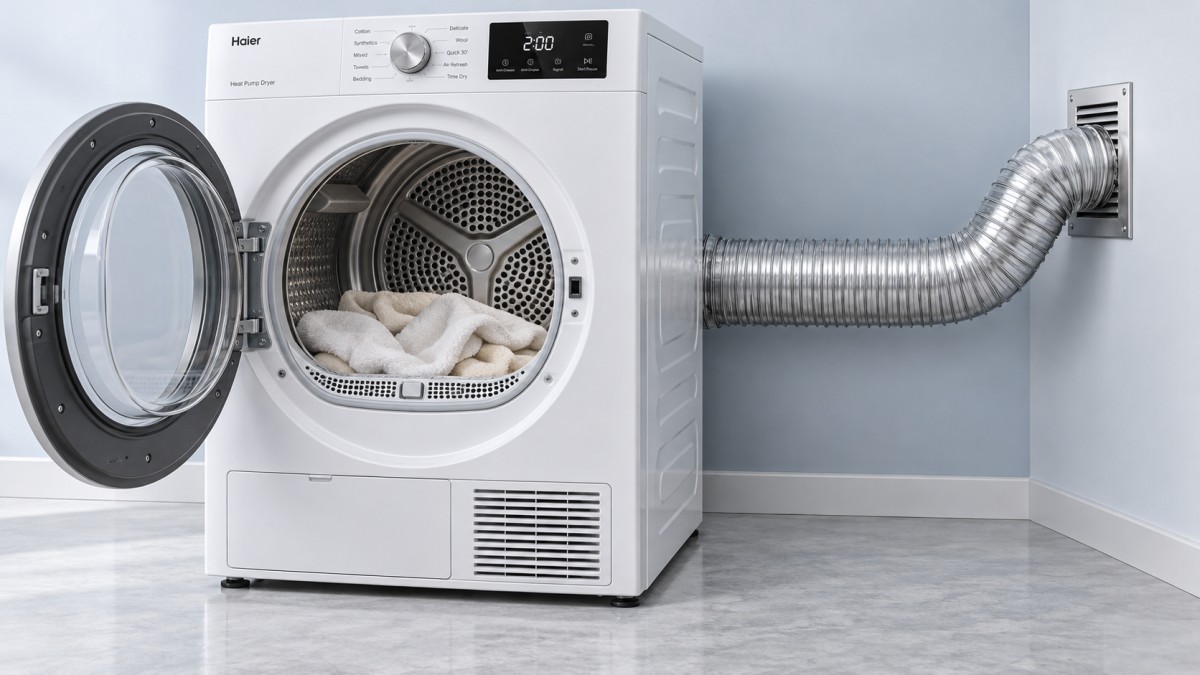
For condenser and heat pump dryers, check internal circulation
These machines normally do not use an outdoor exhaust duct. Focus on the lint filters, accessible heat exchanger surfaces, cooling-air openings where fitted, and condensate collection or drainage system.
Clean only the areas designated for user or technician maintenance. Some heat exchangers are removable; others are fixed or have automatic cleaning systems. Do not rinse a fixed assembly or bend delicate fins while trying to remove lint. A full tank, restricted drain hose, or pump problem may interrupt drying or generate a fault, depending on the model.
Also verify installation conditions. Enclosing a ventless dryer in an unventilated cupboard or operating it outside its specified ambient temperature range can reduce performance even when no component has failed.
Load size: rated capacity is not a promise for every fabric
A drum packed tightly with wet towels leaves little space for tumbling and air circulation. Conversely, one lightweight item may not contact moisture sensors consistently. Both situations can create complaints that resemble a control fault.
Compare the load with the capacity allowed for the selected program, not just the largest capacity printed on the appliance. Separate heavy towels from lightweight synthetics and untangle bedding that has wrapped around smaller items. Confirm that laundry lifts and falls freely rather than rotating as one dense mass.
Check incoming moisture as well. A washer that failed to reach its selected spin speed can send unusually wet laundry to a perfectly functional dryer. Investigate imbalance, interrupted spinning, drainage restrictions, and unsuitable wash settings. Use an additional spin only when the garment care instructions and washer program allow it.
This matters in compact laundry setups, including homes, RVs, and yachts. For example, the XIAOYA Wall-mounted Washer XQG25-1018丨2.5kg has a 2.5 kg wash/spin capacity and a maximum spin speed of 800 rpm. These are washer specifications, not dryer performance claims. When assessing downstream drying, check the actual extraction result and match the wet load to the dryer’s program limits; maximum spin speed alone does not establish residual moisture.
Verify heat without guessing from drum temperature
Once airflow and loading are understood, assess heat under the service manual’s stated test conditions. A hand placed against the door is not a reliable diagnostic instrument. Temperature varies with measurement location, program stage, fabric moisture, and dryer technology.
On some electric dryers, the motor may run even when the heating supply is incomplete. Verify this against the model’s wiring diagram. If a thermal cutoff has opened, identify the underlying cause before replacement; restoring heat without correcting an airflow restriction can recreate the fault.
Heat pump dryers often use lower drying temperatures and may have longer cycles than conventional models. That does not make every long cycle normal. Compare performance with the manufacturer’s reference conditions, accounting for load, initial moisture, ambient temperature, and selected dryness level.
When the hardware checks out, examine program behavior
Automatic programs estimate remaining time from operating conditions. A changing display alone is not proof of failure. Check whether an energy-saving, delicate, or higher-dryness setting explains the customer’s experience.
Inspect moisture-sensing surfaces where fitted, following the approved cleaning procedure. Residue, poor garment contact, wiring faults, or sensor problems can affect automatic cycle decisions. If the service procedure permits, comparing an automatic program with a controlled timed-drying test can help distinguish sensing behavior from a broader drying problem. Keep test conditions consistent.
Close the visit with evidence and a maintenance plan
After corrective work, run a representative load or the prescribed performance test. Record the program, load condition, relevant measurements, drainage or exhaust findings, and final drying result. Avoid promising a fixed cycle time that cannot account for fabric differences.
For distributor and importer service teams supporting OEM/ODM appliances, including XIAOYA products from Shandong Xiaoya Group Household Appliances Co., Ltd., model-specific documentation is essential. Different platforms may use different airflow paths, sensors, and fault logic.
Leave the customer with a short, practical routine: clean filters as instructed, keep approved air passages clear, maintain drainage, and avoid tightly packed mixed loads. Explain what caused the delay and what would justify another service call. A successful repair restores drying performance—and makes the next damp load less of a mystery.
Request A Quote?
Stay updated with our latest news. We promise not to spam!