






How to check a front load washing machine supplier's test reports
Evaluating a front load washing machine supplier requires more than checking whether a test report exists. A report can be genuine and still fail to cover the model, configuration or destination market under review. For quality control and safety professionals, the task is to connect the document to the appliance that will actually be purchased and imported.
This guide follows that connection: from laboratory credentials and model identification to individual test results, production changes and supporting certification evidence. The aim is not to turn every buyer into a test engineer, but to make approval decisions traceable and gaps easier to spot before a shipment is at risk.
Start with the market and the exact appliance
Before assessing a report, define what compliance means for the planned sale. Requirements can differ by destination, appliance function and date of placing the product on the market. Electrical safety is only one part of the picture: electromagnetic compatibility, radio equipment, energy and water performance, chemical restrictions, and labeling may also be relevant. A washer-dryer can have requirements beyond those for a washing-only machine.
Prepare a short specification for the review: destination country, brand, model and variants, rated voltage and frequency, wash and drying capacities, control features, and intended sales channel. Identify whether the appliance has wireless connectivity, a heating element, or a vented or condensing drying system. Ask the importer’s compliance team or a qualified local specialist to confirm the applicable requirements, editions and transition dates.
A report against an IEC standard can be valuable evidence, but it does not automatically establish compliance in every jurisdiction. National or regional deviations, certification procedures and registration obligations may still apply. Likewise, CE marking is a manufacturer’s declaration process for applicable EU legislation, not a certificate issued simply because a laboratory tested one sample.
Check the laboratory and the document’s integrity
Request the complete, final report rather than a cover page or a cropped “pass” summary. It should identify the laboratory, applicant, manufacturer or factory where relevant, report number, issue date, test dates, sample identification, test methods and results. Check that all pages and appendices are present and that amendments or superseding reports are included.
Then verify the laboratory independently. Use the contact details and directories published by the laboratory or its accreditation body, not only links supplied with the document. Where accredited testing is claimed, look for accreditation to ISO/IEC 17025 and confirm that the relevant test method, product category and location fall within the laboratory’s scope for the work performed. Accreditation of a laboratory does not mean every test it performs is accredited.
If the report has been revised, compare the revision history with the version submitted for approval. An older report is not automatically invalid, and a recent one is not automatically sufficient. What matters is whether the tested design remains representative and whether the methods and standard editions meet current market requirements.
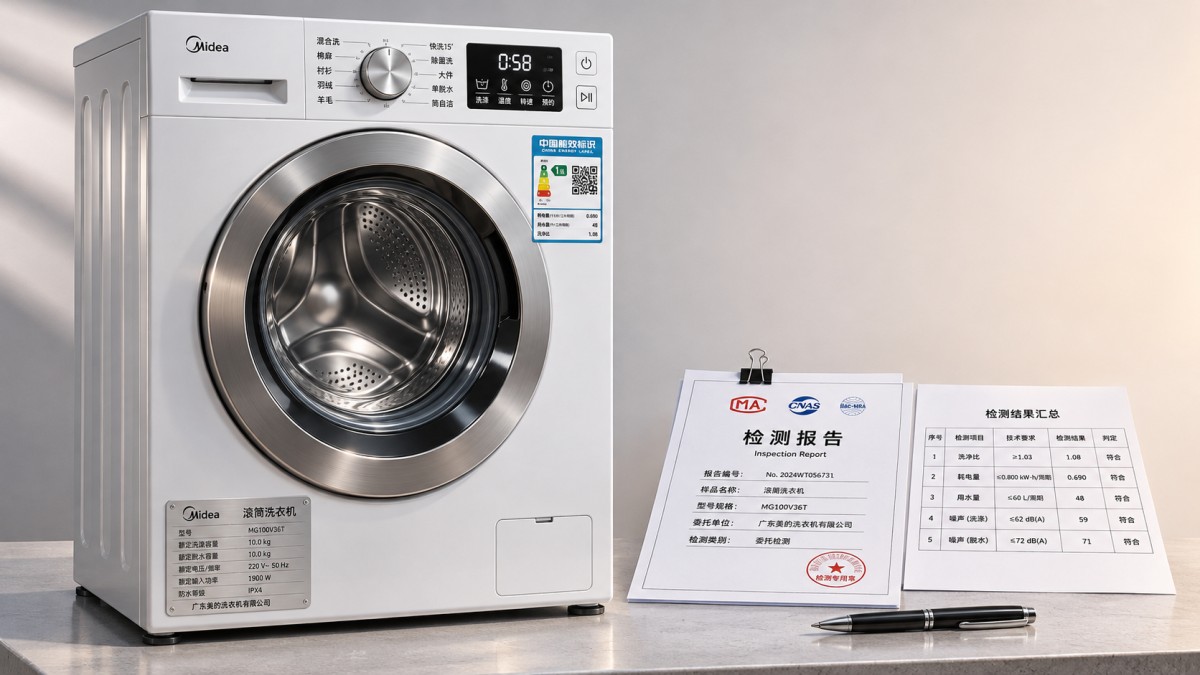
Does the report describe the machine you will receive?
This is often the most consequential check. Compare the report with the product rating label, technical specification, instruction manual, photographs, bill of materials and purchase specification. Look beyond a similar-looking model name.
- Model and brand: Are the ordered model and any private-label names listed? If several models are covered, does the report explain their differences and the basis for grouping them?
- Electrical ratings: Do voltage, frequency, current or power ratings match the destination-market version and its rating plate?
- Construction: Are the motor, heater, electronic controls, door lock, pump, wiring and safety-critical components consistent with the tested sample?
- Functions: Does the scope include drying, steam or wireless features if the supplied unit has them?
- Manufacturing source: Is the relevant factory identified where required by the certification scheme, and can the supplier explain any change of production site?
A family report may legitimately cover several variants, but a model list alone is not always enough. Ask for the model-difference table and the laboratory or certification body’s rationale, especially where variants use different controls, capacities, motors or drying arrangements. Cosmetic changes may be straightforward; a different heater or control board deserves a more careful review.
A practical model-matching example
The XIAOYA Washer-Dryer 97912GE丨10kg/5kg is listed with models 97912GE and 97912GEW, a 10 kg washing capacity and a 5 kg drying capacity. Its published specifications include 110–120 V/60 Hz and 220–240 V/50 Hz supply options, as well as condensing or venting drying options.
For a purchaser, those details are prompts for verification, not evidence that every combination is covered by one report. Confirm the configuration being ordered, which model and electrical rating appear on its label, and whether the applicable report covers its drying method and components. The product information lists ETL, DOE and NRCAN; request the relevant listing, test or registration evidence for the specific model and market rather than treating those references as interchangeable certificates.
Read the test results, not just the conclusion
The conclusion tells you the laboratory’s overall finding for the scope tested. The body of the report shows what that finding rests on. Review the standard number and edition, national deviations, test conditions, clause-by-clause results, observations and any notes describing modifications made during testing.
For a front-loading appliance, safety evidence may address protection against electric shock, temperature rise, moisture resistance, abnormal operation, mechanical hazards and door-related safeguards, depending on the applicable standard and test plan. For a washer-dryer, pay particular attention to evidence covering the drying function and its associated thermal risks. Common safety references include IEC 60335-1 and the relevant particular standards for washing machines and tumble dryers, such as IEC 60335-2-7 and IEC 60335-2-11; the applicable adopted versions and requirements must be confirmed for the destination.
Mark each result carefully. “Pass” is not the same as “not applicable,” “not tested” or “not evaluated.” An N/A entry may be reasonable, but the reason should agree with the actual construction. If a report excludes a drying function that exists on the ordered appliance, the missing coverage needs resolution—not an internal assumption that the washer results are sufficient.
Also check test setup and sample selection. A report might test a worst-case member of a model family, but the basis for that choice should be documented. Where a sample failed and was modified, ask which components changed, whether affected tests were repeated, and whether production units incorporate the final tested design.
Separate safety, performance and certification evidence
These documents answer different questions. A safety test report describes testing and results for a defined sample and scope. A certification or listing record shows a certification body’s decision under its scheme, which may include additional conditions such as factory surveillance. Energy or water performance reports support claims or regulatory filings under their own test procedures. One should not be used as a substitute for another.
For North American sales, for example, check the relevant certification body’s public listing where available, as well as applicable US Department of Energy and Canadian Natural Resources Canada requirements. An ETL listing, DOE-related evidence and NRCan-related evidence serve different purposes. Their relevance depends on the market and product; their presence should be verified against the exact model rather than inferred from a logo on a specification sheet.
Investigate gaps before approving the supplier
A missing appendix, an unexplained model suffix or a different component reference is not necessarily proof of a noncompliant machine. It is, however, a reason to pause. Record the discrepancy, its potential impact and the evidence needed to close it. Useful follow-up requests include:
- The complete report and any amendments, including model-difference and critical-component lists.
- Current certification records or listing numbers, with the legal manufacturer and factory identified.
- A comparison of the tested sample against the production specification and current rating label.
- Evidence supporting substitutions of safety-critical parts, including any required assessment or approval.
- Applicable energy and water test results, labels and registration details for the intended market.
- A written explanation of unresolved exclusions, failed tests, design changes or production-site changes.
Be cautious when a supplier will provide only a certificate image, claims that one report covers every country, or cannot explain why the report’s ratings differ from the product label. If confidentiality is the concern, agree on controlled access or a nondisclosure arrangement. If the evidence still cannot be verified, escalate to the compliance owner or seek an independent assessment before release.
Keep the evidence connected to production
Approval is a snapshot. A valid report for a preproduction sample does not by itself prove that every later unit is identical. Build document control into the purchasing process: retain the approved specification, report revision, component list, labels and certification records alongside the purchase order. Define which changes require notification and reassessment, including changes to the control board, door interlock, heater, motor, wiring, factory or software affecting safety functions.
For OEM and ODM projects, responsibilities should be explicit. Agree who maintains the technical file, monitors market requirements, owns registrations, approves artwork and manages changes after launch. Shandong Xiaoya Group Household Appliances Co., Ltd., founded in 1979, manufactures front-loading washing machines, wall-mounted mini washers and tumble dryers and offers OEM and ODM services. In any supplier relationship, the practical question remains the same: can both parties trace the evidence to the configuration being produced for the intended market?
A sound review ends with a documented decision, not merely a folder full of PDFs. Record what was accepted, what remains open, who approved any limitations and when the evidence should be reviewed again. That discipline gives quality and safety teams a clearer basis for purchasing—and a faster way to respond when a model, component or regulatory requirement changes.

Request A Quote?
Stay updated with our latest news. We promise not to spam!