






Sensor Drying vs. Timed Drying: How Dryer Controls Affect Clothes
A mixed load leaves the dryer with dry shirts but damp towel seams. Adding another timed cycle may finish the towels while exposing the shirts to unnecessary heat and tumbling. Sensor drying generally adapts better to changing loads and initial moisture levels; timed drying provides a fixed duration but cannot determine whether the clothes are actually dry. Neither approach guarantees uniform results when fabrics dry at different rates.
The practical comparison is therefore not simply “automatic versus manual.” It is whether the control system reaches a repeatable moisture endpoint without excessive thermal exposure, energy use, or damp items. Sensor placement, feedback processing, temperature limits, and load movement all affect that outcome.
What each control method actually controls
A timed program runs for the selected duration, usually with temperature regulation and protective limits operating separately. Fixed time does not necessarily mean continuous heating: heaters or compressors may cycle or modulate, and part of the program may be reserved for cooling. The missing feedback is an automatic decision that the laundry has reached the desired dryness.
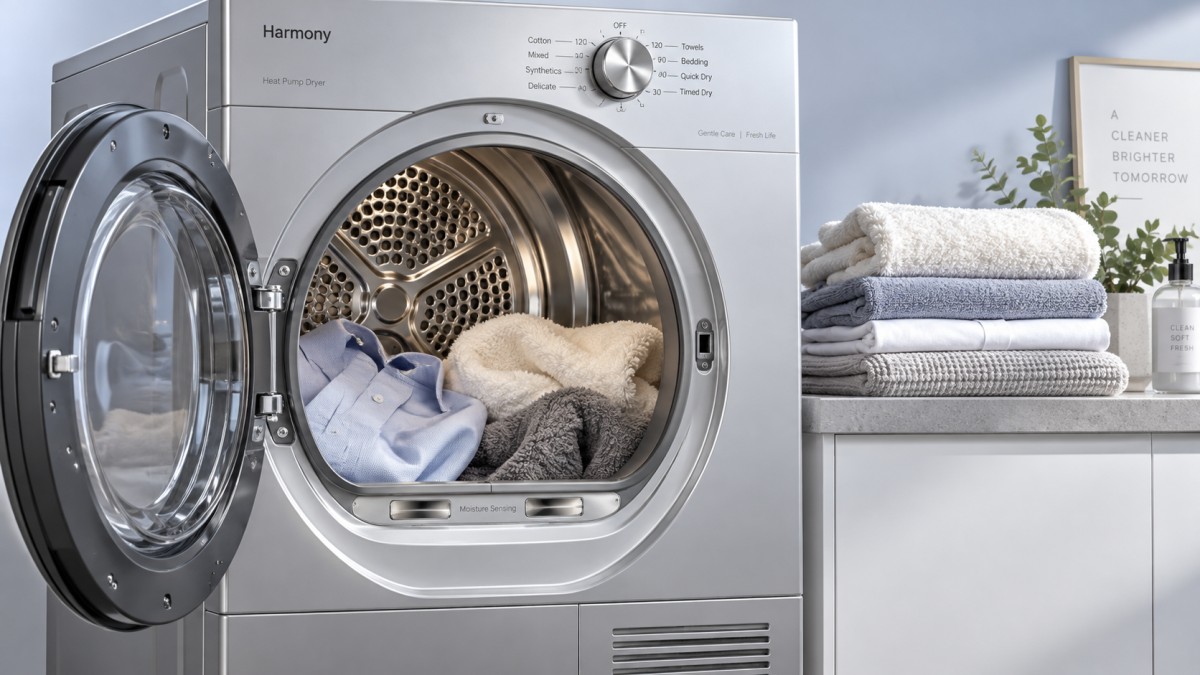
Sensor drying uses measured signals to estimate progress and determine when to end the drying phase. Conductivity-based systems commonly use metal electrodes that wet fabric bridges as it tumbles. The controller interprets changing contact signals rather than directly measuring the moisture content of every garment.
Other designs use air temperature, humidity, or combinations of signals. Temperature-based estimation relies partly on how evaporation affects the thermal behavior of the load and air stream. Its accuracy depends on the design and operating conditions. A “sensor dry” label alone does not identify the sensing architecture, sampling logic, or endpoint performance.
Why the same dryness setting can produce different clothes
Near the end of drying, less water remains available for evaporation. Continued energy input increasingly raises textile temperature rather than removing substantial moisture. Unnecessary exposure can contribute to shrinkage, loss of elasticity, or other damage in susceptible materials. Care-label restrictions remain applicable even when automatic moisture control is available.
Dryness control and temperature control solve different problems. A moisture sensor may help decide when to stop, but it does not establish a safe temperature for every fabric. Conversely, a low-temperature timed program can still run longer than necessary and add avoidable mechanical wear.
Mixed fabrics create an endpoint conflict
Light synthetics may dry before thick cotton hems, waistbands, or towel edges. A sensor can correctly detect repeated contact with dry articles while wetter sections receive less exposure or remain inside a tangled bundle. Extending the dryness setting may finish those sections at the expense of already-dry items. Separating loads by fabric and thickness is often more effective than changing the control mode.
Small loads can weaken the feedback signal
A single garment may not contact the electrodes often enough to provide representative measurements. Some controllers compensate through minimum run times or other logic, but that behavior requires verification. Where the operating instructions permit it, a short timed finish can be appropriate for an isolated damp item. Use a fabric-compatible temperature and inspect the result rather than repeatedly adding long intervals.
Residue on accessible sensing surfaces can also affect electrical contact. Follow the specified cleaning method; do not assume abrasive cleaning is acceptable. Restricted airflow, lint accumulation, or an obstructed installation can change drying behavior under either control method. Longer cycles should trigger an airflow and maintenance check before a change to endpoint settings.
Control the water entering the dryer first
An endpoint comparison becomes misleading when the starting loads contain different amounts of water. Washer extraction, textile absorbency, and load distribution all affect the drying task. Record initial moisture rather than assuming that equal spin-speed settings produce equal extraction.
For example, the XIAOYA Washer 97912E丨10kg is specified with a 10 kg washing/spinning capacity and a maximum spin speed of 1400 rpm. These are relevant upstream parameters when preparing test loads, not evidence of dryer sensing capability. Its actual post-spin moisture must still be measured for the selected fabric and program.
The washer’s rated capacity also does not establish a suitable drying load. Use the dryer’s program-specific capacity limits, especially for synthetics and delicate fabrics.
A comparison test that separates control quality from heat input
Start with a declared endpoint, such as laundry ready for storage or intentionally retaining moisture for ironing. Without an endpoint definition, a shorter cycle may simply be leaving more water behind, while a longer cycle may be delivering an unnecessarily dry result.
- Prepare repeatable loads. Use defined textile composition, dry mass, and conditioning. Include representative nominal loads, small loads, and mixed-thickness challenges. Keep challenge tests distinct from standardized performance tests.
- Measure starting moisture. Weigh each load before drying and establish its dry reference mass using the applicable test procedure. Calculate moisture relative to that reference, not from touch alone.
- Hold operating conditions steady. Record ambient conditions, supply conditions, installation configuration, filter condition, and any relevant drainage or water-container state.
- Match the intended outcome. Compare sensor and timed programs at equivalent achieved dryness. Record temperature selections and cooling behavior; equal cycle names do not establish equivalent operation.
- Capture more than duration. Measure energy per cycle, final moisture, and repeatability. Assess individual articles or defined fabric groups so an acceptable load average does not conceal damp heavy items.
- Repeat under controlled variation. Change initial moisture and load size deliberately. Observe whether the automatic endpoint remains consistent and how much manual time adjustment the timed program requires.
A useful moisture expression is: moisture content (%) = (measured textile mass − reference dry textile mass) ÷ reference dry textile mass × 100. State the reference-mass preparation and weighing procedure because different conventions can produce different reported values. Prompt, consistent handling reduces changes caused by evaporation or moisture uptake after unloading.
Standards evidence and the limits of a feature label
IEC 61121 provides performance measurement methods for household tumble dryers. For a formal evaluation, identify the applicable edition, amendments, and market-specific requirements before testing. Load preparation, selected programs, conditioning, and calculations must follow the chosen procedure if results are presented as standards-based.
Do not treat a sensor feature, a product certification, and a performance test report as interchangeable evidence. Request the sensing principle, available dryness settings, program capacity limits, maintenance instructions, and the relevant test conditions. Comparative energy claims need equivalent drying outcomes, not just lower meter readings.
For variable household loads, prefer sensor control when repeated testing demonstrates stable final moisture across the intended operating range. Retain timed drying for permitted finishing tasks or predictable loads with established durations. If an automatic program repeatedly leaves damp seams while overdrying lighter articles, investigate load separation, sensing conditions, and endpoint calibration rather than assuming that a longer cycle resolves the underlying control problem.
Request A Quote?
Stay updated with our latest news. We promise not to spam!