






Washing Machine Spin Speed: When Does a Higher RPM Actually Help?
A higher spin speed helps when it removes enough additional water to shorten the next drying stage without compromising fabric care, stability, or cycle time. For a washing machine handling cotton towels before tumble drying, that benefit can be meaningful. For a small delicate load or an unbalanced duvet, a higher maximum RPM may deliver little practical improvement because the selected program limits speed or the machine cannot sustain it.
The useful comparison is therefore not simply 1,200 versus 1,400 RPM. It is residual moisture at the end of a comparable cycle, together with achieved spin speed, extraction time, noise, and subsequent drying energy. A machine with a higher headline rating is not necessarily the better-performing option under the loads that matter.
RPM describes rotation, not extraction performance
During spinning, water moves through the textile load and drum perforations toward the outer tub, then leaves through the drainage system. The centrifugal acceleration at the drum wall depends on both rotational speed and drum radius:
a = (2πn / 60)2 × r, where n is speed in revolutions per minute and r is drum radius in metres.
At the same radius, increasing speed from 1,200 to 1,400 RPM raises calculated centrifugal acceleration by approximately 36%. This is a mathematical comparison, not a prediction of 36% less retained water. Extraction also depends on textile structure, load distribution, drainage, and time at speed. As easily removable water leaves, further extraction generally becomes less productive.
Drum geometry matters when comparing different designs. At equal RPM, a larger drum radius produces greater centrifugal acceleration at the wall. Rated load capacity alone does not establish that radius, so request drum dimensions rather than inferring extraction performance from capacity or cabinet size.
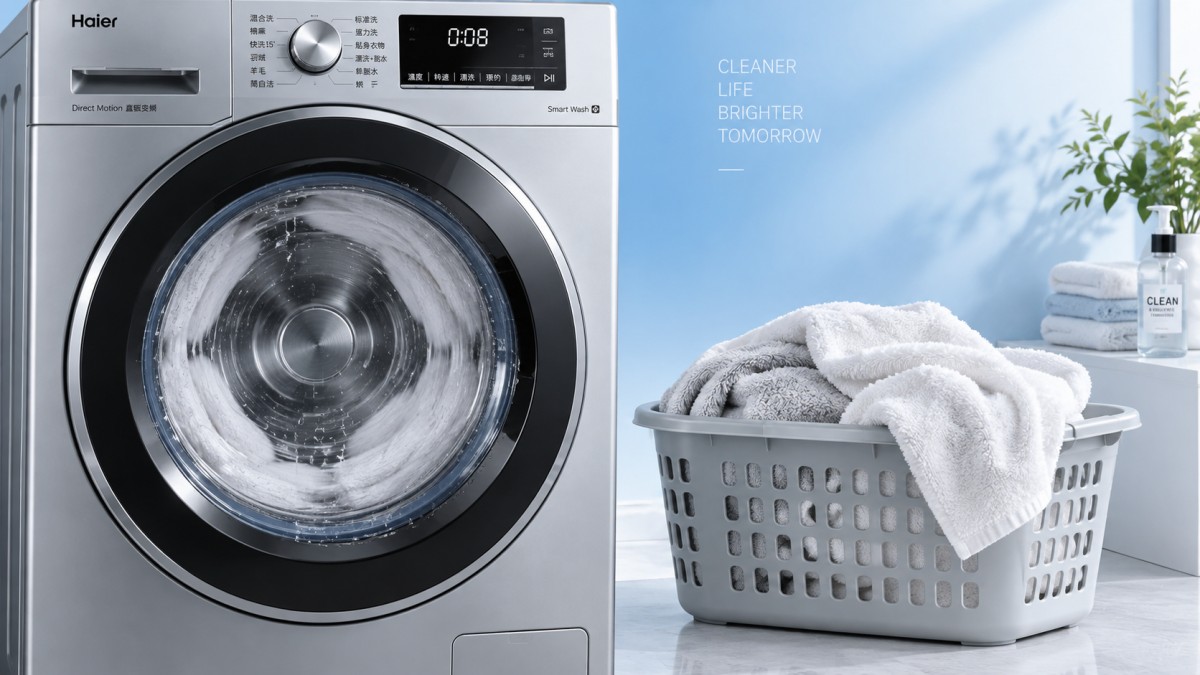
Measure the water left behind
Residual moisture content provides a more useful outcome metric than maximum speed. For a defined test load, it can be expressed on a dry-mass basis:
Residual moisture (%) = [(post-spin mass − dry reference mass) / dry reference mass] × 100.
The dry reference must follow a defined preparation method. A casually air-dried load is not necessarily a consistent baseline because textiles exchange moisture with surrounding air. For formal comparisons, use the applicable standardized conditioning, load preparation, and weighing procedures.
As an illustrative calculation, a 5 kg dry reference load weighing 8 kg after spinning retains 3 kg of water, giving 60% residual moisture. At 7.5 kg after spinning, it retains 2.5 kg, giving 50%. The difference is 0.5 kg less water entering the dryer—not a guaranteed reduction of any particular number of drying minutes.
For household washer performance evaluation, IEC 60456 provides relevant measurement methods. Confirm the applicable edition, regional adoption, and required test program before comparing reports. Results produced with different textiles, loads, or conditioning procedures should not be treated as directly equivalent.
Where higher speed earns its place
For tumble-dried loads, compare the whole laundry process. Extra spin energy may be offset by reduced dryer energy, but the balance depends on dryer technology, textile type, and the actual moisture reduction. For line drying, the benefit appears mainly as shorter drying time rather than a direct reduction in drying-appliance electricity.
A maximum-speed rating can conceal a slower finish
A washer may advertise a speed available only on particular programs. Delicate, synthetic, quick, or reduced-load cycles can use different limits. Even an eligible cotton cycle may reduce speed when imbalance detection identifies an unsuitable load distribution.
Record the speed profile, not just the peak. A brief touch at maximum RPM does not describe extraction as well as the combination of acceleration, sustained speed, and time. Redistribution attempts also matter: a nominally faster machine may spend longer rearranging a troublesome load before completing its final spin.
When laundry remains wetter than expected, check the selected program and load composition first. Then examine drainage restrictions, installation stability, and any recorded imbalance interventions. Slow drainage can limit extraction despite drum rotation. Persistent knocking, cabinet movement, or abnormal mechanical noise warrants stopping the test and checking installation or servicing requirements—not overriding protective controls to force a higher speed.
Mechanical design sets the operating boundary. Suspension, bearings, drum assembly, motor control, and cabinet stiffness must accommodate the specified operating envelope. Higher RPM increases the excitation associated with a given imbalance, but speed alone does not prove poor durability. Reliability judgments require relevant validation evidence, not assumptions based on the specification sheet.
Build a comparison that isolates the speed effect
To evaluate whether a higher setting is worthwhile, separate a controlled speed comparison from a complete product comparison. Changing both program and speed can alter rinsing, duration, and load handling, making the cause of any improvement unclear.
- Define the representative load. Keep textile composition, dry mass, preparation, and loading procedure consistent. Include a separate difficult-load assessment if bulky items are important.
- Hold other settings constant where possible. Use comparable washing and rinsing conditions, then change only the permitted final-spin setting.
- Measure extraction and operating behaviour. Record post-spin mass promptly, cycle duration, electrical energy, achieved speed profile, and balancing interruptions.
- Evaluate noise under repeatable conditions. Keep installation, floor conditions, microphone position, and measurement method consistent. Distinguish normal airborne spin noise from structure-borne vibration.
- Repeat through the drying stage. Use the same dryer program and comparable endpoint dryness, recording drying time and energy rather than relying on an estimated time display.
Use repeated runs to assess variability. One unusually well-balanced load can make a speed setting look more effective than it is in routine operation. Where formal noise or energy claims are required, use the applicable prescribed methods rather than presenting internal screening results as certification evidence.
Match the dryer to the extracted load
A washer-to-dryer evaluation also needs a compatible load size. Washer and dryer capacity ratings normally refer to dry textile mass, not the wet mass transferred after spinning. Check both appliance manuals and program limits; matching cabinet widths does not establish matching usable capacity.
For a vented-dryer pairing, the XIAOYA Vented Dryer XH80-Z711丨7kg provides a specified 7 kg drying capacity, Sensor Dry, Time Dry, and selectable high, medium, and low heating temperatures. These features support evaluating different drying settings, but they do not establish a particular energy saving from higher washer RPM. Keep the drying endpoint consistent and maintain the specified exhaust arrangement and lint-filter condition during comparisons.
The decisive evidence is a repeatable reduction in retained water that improves the intended workflow. When an additional speed step produces little moisture reduction but adds balancing delays, objectionable vibration, or unacceptable creasing, the lower setting is the stronger operating choice—even if the machine can spin faster.

Request A Quote?
Stay updated with our latest news. We promise not to spam!