






What Does Washing Machine Capacity Mean for Everyday Laundry?
What Does Washing Machine Capacity Mean for Everyday Laundry?
Choosing a washing machine often starts with a simple question: how much laundry can it actually handle? Capacity usually refers to the maximum weight of dry laundry a machine can wash on a specified cycle—not how much wet clothing fits inside the drum. Understanding this difference helps you avoid overloading, get better cleaning results, and choose a size that suits your household.
The number on the label is a useful starting point, but it does not tell the whole story. Fabric type, program selection, bulky items, and whether you plan to dry the same load all affect what that capacity means in practice.
The kilogram rating is a limit, not a loading target
An 8 kg rating generally means the washer can handle up to 8 kg of dry textiles under the conditions specified for its rated program. It does not mean every cycle accepts that amount. A cotton program may allow the full rated load, while wool, synthetics, delicates, and quick-wash programs can have lower limits. The program table in the manual is more useful than the headline capacity when deciding what to load.
Water absorbed during washing does not count toward the dry-load rating. You do not need to calculate the weight of soaked towels. Instead, check the laundry before washing. For a practical measurement, weigh yourself holding the dry basket, subtract your weight without it, and then subtract the empty basket’s weight.
There is also no need to reach the maximum every time. A smaller load may be appropriate when sorting fabrics or separating heavily soiled workwear. Where available, load-sensing features can adjust aspects of operation, but their presence does not guarantee identical efficiency across all load sizes.
Why a full drum may still be the wrong load
Weight and volume are different constraints. A bundle of light fleece can occupy more space than heavier cotton garments. In a front-loading washer, clothing needs room to lift and fall as the drum turns. Packing it tightly can restrict that movement, even when the dry weight is below the stated limit.
Load garments loosely rather than pressing them into gaps. Follow the manufacturer’s loading guidance; a visual gap or “hand-width” rule is only a rough check, not a substitute for the program limit. Laundry trapped against the door seal is a clear reason to stop and rearrange the load.
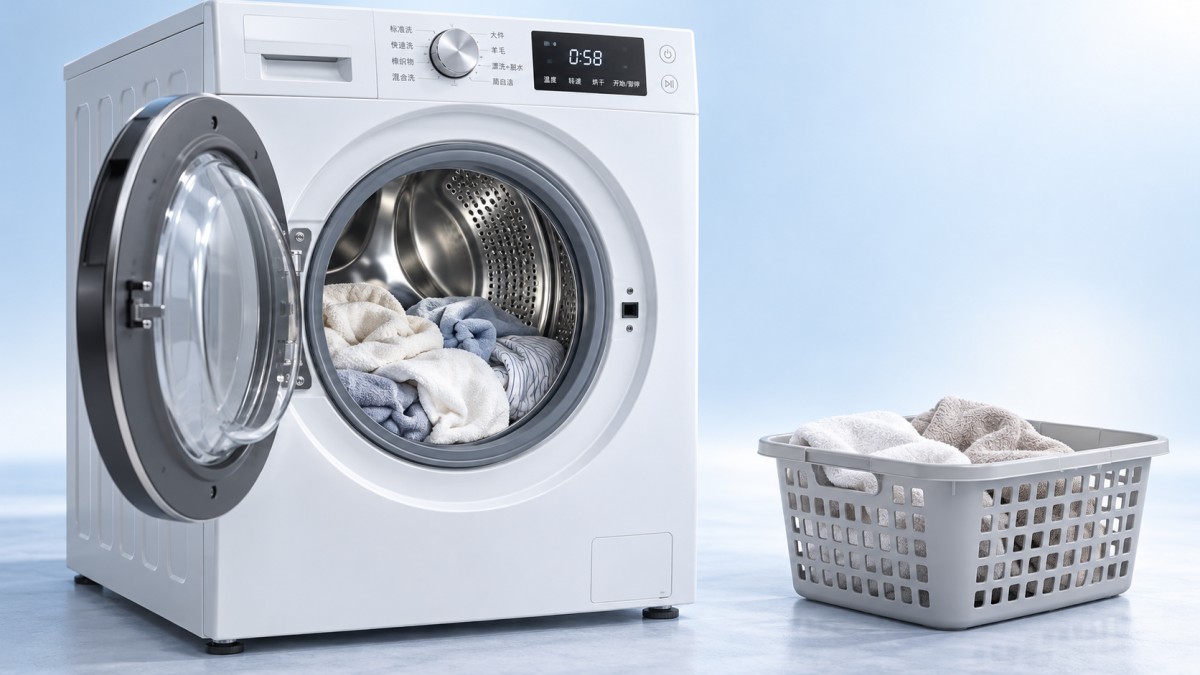
Overloading can leave detergent insufficiently rinsed out or clothes unevenly cleaned. An unbalanced load can also interrupt spinning. However, vibration alone does not prove the machine is overloaded: installation, leveling, and a single absorbent item can cause similar symptoms. Check those conditions before assuming you need a larger washer.
Bedding needs a separate judgment
A duvet that fits through the door is not automatically suitable for washing. Its filling, care label, and bulk matter, as does the washer’s bedding guidance. A dense blanket may become difficult to balance after absorbing water. If the item must be compressed into the drum, a larger suitable machine or professional cleaning may be the better option. Never assume that a general kilogram rating guarantees compatibility with every bedding size.
Washer-dryer capacity has two numbers for a reason
Combination machines often display separate washing and drying capacities. Both describe dry textile weight, but the drying limit is commonly lower because drying requires space for tumbling and moisture removal. The difference matters most when you want one uninterrupted wash-and-dry cycle.
For example, the XIAOYA Washer-Dryer 75912GE丨8kg/4kg specifies an 8 kg wash/spin capacity and a 4 kg drying capacity. A full 8 kg wash load therefore cannot simply continue into drying as one full load. You would need to remove part of it, or start with a load within the applicable wash-and-dry program limit.
Its maximum spin speed is 1400 rpm, but spin speed does not increase drying capacity. Effective spinning can reduce the moisture left in suitable fabrics before drying; the permitted load and actual spin speed still depend on the selected program. Likewise, a 20-minute quick wash should not be read as a promise to wash the full rated capacity in that time.
Choose around your laundry rhythm, not just household size
A household headcount misses important differences. Two people with uniforms, gym clothing, and frequent towel changes may generate more laundry than a larger household that washes little and often. The useful question is: what is your largest regular load after sorting?
- Frequent small washes: Check the smaller-load programs rather than buying extra capacity you rarely use.
- Weekend batch washing: Weigh a typical sorted load to see whether additional capacity would actually reduce separate cycles.
- Frequent machine drying: Compare drying capacity first if unloading wet laundry halfway through would be inconvenient.
- Occasional oversized bedding: Check item compatibility separately instead of sizing every daily wash around one unusual load.
A bigger rating does not automatically mean lower running costs. Compare the relevant energy and water information under equivalent local test conditions, and consider how you will actually load the machine. Repeatedly running a large washer with very small loads may not deliver the savings you expected.
What to confirm beyond the capacity label
Capacity also says little about installation space. The example model measures 600 × 550 × 850 mm, but appliance dimensions alone are not a complete installation envelope. Allow for hoses, connections, door movement, and the clearances specified in the installation instructions.
For distributors and importers, clear capacity communication helps prevent mismatched expectations. Founded in 1979, Shandong Xiaoya Group Household Appliances Co., Ltd. develops and manufactures front-loading washers, wall-mounted mini washers, and tumble dryers, with OEM and ODM services for international markets. Across these formats, customer-facing information should distinguish rated washing capacity, program-specific limits, and drying capacity rather than presenting one number as universal.
Before choosing a washing machine, weigh a normal sorted load, identify your bulkiest regularly washed item, and decide how often you need automatic drying. Then check those needs against the program table and installation instructions. That is a more reliable route to the right capacity than buying the largest number that fits your budget.

Request A Quote?
Stay updated with our latest news. We promise not to spam!