






Buying the XH80-Z711 Dryer: Warranty and Spare Parts Questions
Buying the XH80-Z711 Dryer: Warranty and Spare Parts Questions
Before placing a bulk order for the Vented Dryer XH80-Z711丨7kg, look beyond the unit price and ask what happens when a machine needs attention after delivery. Warranty coverage, replacement-part availability, and responsibility for local repairs can change the economics of an otherwise attractive purchase.
The available information does not establish this model’s warranty duration, parts stock, or service response commitments. Those points need written confirmation. For an importer, the useful question is not simply “Does it have a warranty?” It is “Can we resolve a customer’s fault without an open-ended cost or delay?”
Start with the warranty clock—and who pays for the repair
Ask when coverage begins: factory dispatch, shipment, arrival, or retail sale. This matters when dryers spend time in transit and then sit in a distributor’s warehouse. A warranty measured from shipment may leave less support time after the customer actually buys the appliance. If coverage starts at retail sale, agree on acceptable proof and any maximum period after shipment.
Then separate replacement parts from the rest of the repair bill. A free component does not necessarily cover diagnosis, technician travel, labor, courier charges, import duties, or a return visit. The supply agreement should allocate these costs rather than leave them to negotiation after a failure.
- Which components are covered, and are any subject to different terms?
- What evidence is required before a claim is approved?
- Can an authorized local technician repair the dryer without returning the complete unit?
- How are arrival defects, transport damage, and repeated faults handled?
- Does a replacement part receive its own coverage period or follow the original appliance warranty?
Keep the supplier’s commercial warranty separate from your obligations to retail customers. Depending on the destination market, those obligations may differ. A factory warranty should not be assumed to satisfy every local consumer-protection requirement.
For a vented dryer, installation can complicate a claim
Consider a dryer reported as taking too long to dry. A technician needs to distinguish a machine fault from restricted exhaust airflow, unsuitable duct routing, a blocked outlet, or an inappropriate load. Without clear installation instructions, the distributor may struggle to explain why a service visit is—or is not—covered.
Request the XH80-Z711 installation manual before approving packaging and customer literature. Confirm the specified exhaust connection, permitted duct arrangement, clearances, electrical requirements, and maintenance instructions. Do not borrow these details from another dryer, even one with the same nominal capacity.
Installation-related exclusions should be specific enough to investigate. Ask what evidence establishes incorrect installation and who makes that determination. Photos of the exhaust route, the rating label, and the reported operating conditions can help resolve a claim; a vague “misuse” exclusion usually does not.
“Spare parts available” needs a more precise answer
Availability can mean a part is stocked for dispatch, obtainable through a component supplier, or manufactured only with a future production run. These are very different service arrangements. Ask for an illustrated parts list and a model-specific service bill of materials, with part numbers linked to the version you intend to buy.
Review service items such as door hardware, filters, drive components, heating and temperature-control components, and controls, where fitted. Treat these as categories to verify—not a confirmed component list for this model. For each relevant part, request its price, minimum order quantity, normal lead time, and urgent-shipment options.
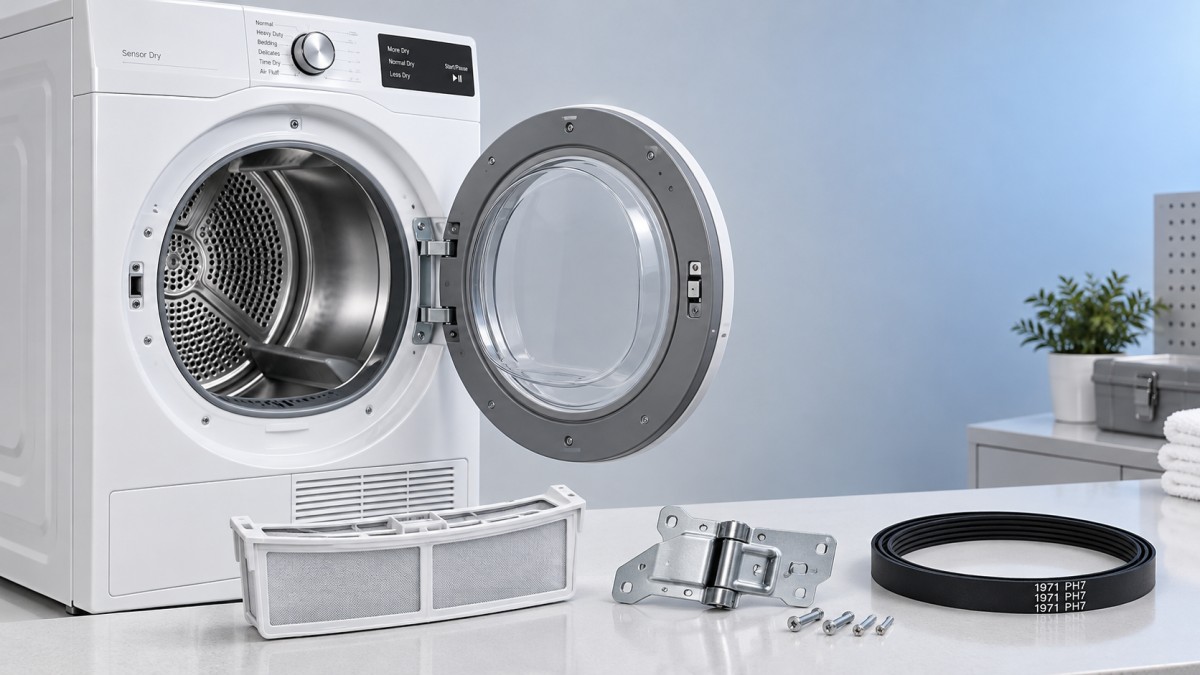
The most useful visual here is an exploded parts drawing with numbered references. A clear drawing helps a service agent order the correct assembly rather than describe a component through photographs and email exchanges.
Pay particular attention to production changes. A control assembly with a similar appearance may use different firmware, connectors, or electrical specifications. Ask how serial numbers identify revisions and how superseded parts are documented. Also agree on the support period after the model is discontinued; support during active production alone may not meet your needs.
Build the opening parts order around repair exposure
Avoid accepting a generic spare-parts allowance without seeing its contents. Ask the supplier to explain the proposed starter kit using available service records, component costs, and replenishment times. If model-specific history is unavailable, acknowledge that gap and review the stock plan after initial sales.
Small, inexpensive parts that can stop a repair are often sensible local-stock candidates. Expensive assemblies require a different decision: tying up cash may be justified where international replenishment would leave customers waiting, but not every distributor needs the same inventory. Base the choice on your service territory and promised turnaround.
Keep model evidence separate when comparing the range
Shandong Xiaoya Group Household Appliances Co., Ltd., founded in 1979, manufactures front-loading washing machines, wall-mounted mini washers, and tumble dryers, and offers OEM and ODM services for overseas buyers. That breadth is relevant when discussing a laundry range, but it does not establish a common warranty or interchangeable parts across products.
For example, the XIAOYA Washer-Dryer 75912GE丨8kg/4kg is a combination appliance with a listed 8kg washing capacity, 4kg drying capacity, and maximum spin speed of 1400rpm. It serves a different selection need from a standalone 7kg vented dryer. Its listed ETL, DOE, and NRCAN references should not be transferred to the XH80-Z711; request the applicable documents and exact configuration for each model.
For private-label orders, clarify whether customized controls, labels, or finishes create separate replacement-part requirements. Branding flexibility is useful only if the service team can still identify and obtain the right version later.
Test the claim process before committing to volume
During sample evaluation, run a paperwork exercise: submit a hypothetical fault report with a serial number, symptoms, photographs, and technician findings. Ask who reviews it, what further checks would be needed, and how an approved part would reach your repair agent. This tests the proposed workflow without pretending that a response-time guarantee already exists.
Before issuing the bulk purchase order, attach the agreed warranty schedule, parts list, service documentation, cost allocation, and claim procedure to the contract. Include escalation contacts and a process for unresolved or repeated faults.
A lower quotation may still be worth choosing when support is limited, provided you have priced the local inventory and service work yourself. What should delay approval is uncertainty: no identifiable replacement parts, no written cost responsibility, or no workable route from a customer complaint to an authorized repair.

Request A Quote?
Stay updated with our latest news. We promise not to spam!