






Should your front load washing machine supplier stock spare parts?
Should Your Front Load Washing Machine Supplier Stock Spare Parts?
A front load washing machine supplier should do more than deliver reliable appliances—it should also support the people who keep them running. For after-sales maintenance teams, access to compatible spare parts can make the difference between a quick repair and a prolonged service delay. But which components should a supplier stock, and how does parts availability affect repair costs and customer satisfaction? The answer depends less on the size of a parts catalogue than on whether the right component can reach the technician when it is needed.
In most cases, the answer to the headline question is yes: a supplier should hold, or have dependable access to, spare parts for the machines it sells. That does not mean every component must sit in every regional warehouse. It does mean the supply arrangement should be clear before the first machine enters service—not after a door lock fails and a customer is waiting for a repair date.
A parts list is not the same as parts support
A supplier may provide an exploded diagram and an extensive list of part numbers, but neither document confirms that those parts are available. Some items may be held at the factory, some sourced from component manufacturers only after an order, and others replaced by a newer revision. The practical question is not simply “Can you supply it?” but “Where is it, how is it identified, and when can it realistically be dispatched?”
Consider a washer that stops with water in the drum. A drain pump is one possible cause, but a blocked filter, obstructed hose, wiring fault or control issue may produce a similar complaint. Even after the pump is confirmed faulty, the technician still needs the correct assembly for the machine’s production version. A generic description such as “front-load drain pump” is rarely enough to support a confident order.
Ask for a sample lookup using a model number and serial number from the proposed range. A useful response should identify the part number, any approved replacement, stock location and the information needed to place an order. If the supplier cannot complete that exercise before purchase, the maintenance team may struggle to do it under pressure later.
Which washing machine parts deserve priority?
The best initial inventory is based on the installed models, expected usage and the consequences of a delay. A component that is inexpensive but rarely needed may be less urgent than a model-specific part that stops the machine completely. Equally, stocking an expensive assembly for every possible failure can tie up money without improving service.
For a new front-load range, discuss these groups with the supplier:
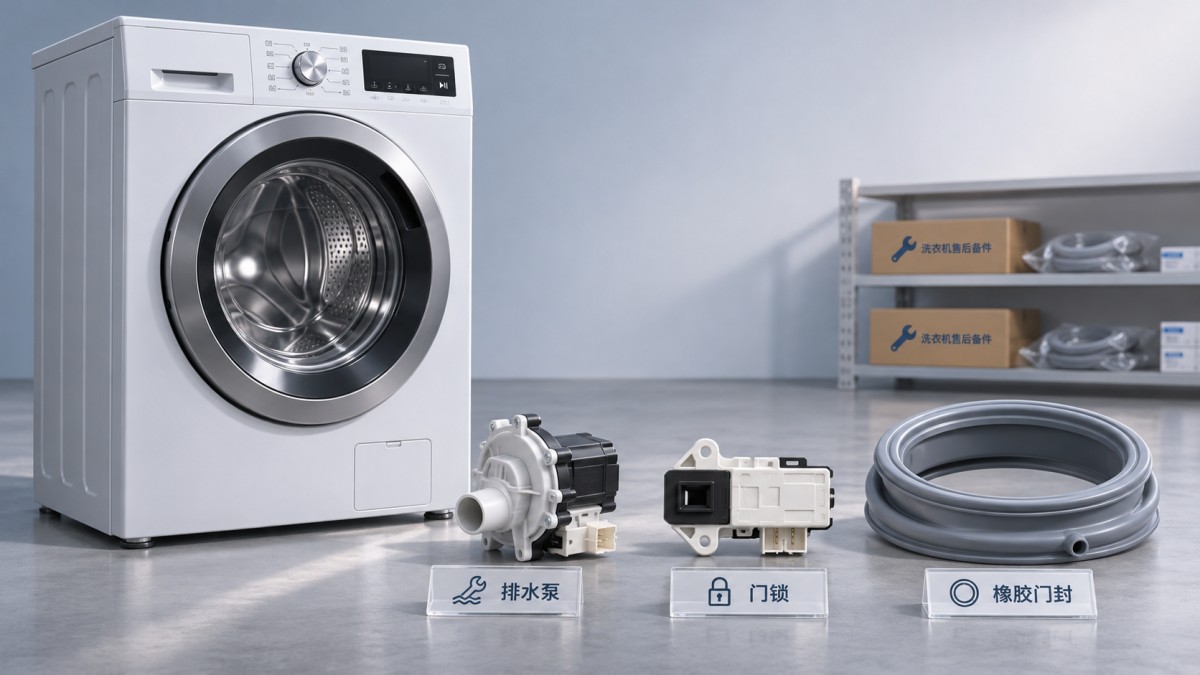
- Service-access components: door locks, handles and door seals. A damaged seal may leak, while a faulty lock can prevent a cycle from starting. Check whether seals vary by cabinet or door design.
- Water-path components: drain pumps, inlet valves and relevant hoses. Confirm the electrical rating, connectors and mounting arrangement rather than ordering by appearance alone.
- Electrical and control parts: sensors, wiring assemblies and control boards. These can be difficult to substitute; some boards may require model-specific configuration or programming.
- Drive and suspension parts: belts, motors, dampers and related fittings where applicable. Their design differs across models, so ask whether the part is supplied separately or as a larger assembly.
- Major structural assemblies: drums, tubs and bearings where serviceable. These are bulky or labor-intensive to replace, making a central stock or special-order arrangement more practical in some markets.
This is a starting point, not a universal shopping list. Review actual service records as they accumulate. If a particular door seal is frequently damaged during installation or use, keeping it locally may be sensible. If a large tub assembly is rarely requested and takes substantial storage space, a confirmed replenishment route may be the better compromise.
Also establish what arrives with an assembly. A replacement pump may or may not include its housing, seals or fasteners. A control board may arrive without a required harness. Those details affect whether the technician can finish the job on the next visit.
Match the part to the production version, not just the model name
Model names are useful for sales; serial numbers, production dates and revision codes are often more useful for repairs. Manufacturers can change component suppliers, connectors or board revisions during a product’s life. Two machines carrying the same retail model name may therefore need different parts.
Before approving a supplier, ask how those changes are communicated. Ideally, the parts catalogue should show the applicable serial-number range or revision, superseded part numbers and any fitting instructions. If a replacement is backward-compatible only with an additional harness or software update, that condition should be visible at the ordering stage.
Electrical specifications matter particularly in export programs. A component designed for one voltage and frequency should not be assumed suitable for another. Regional plugs, display language, control-board settings and local product variants can also complicate an otherwise straightforward replacement. For OEM and ODM ranges, agree on who maintains the cross-reference between the customer-facing model number and the manufacturer’s internal bill of materials.
A photograph can help identify a part, but it is not a substitute for a controlled part number. Similar-looking valves or boards may have different ratings, connections or functions. When the records conflict, pause the order and obtain written confirmation rather than asking a technician to make the part fit.
Stock location changes the real cost of a repair
A low unit price is attractive until the part requires an international shipment, customs clearance and another technician visit. The relevant figure is the cost of completing the repair: the component, freight, handling, labor, return visits and any commitments made to the customer. An unavailable low-cost part can be more disruptive than a more expensive item already held locally.
There are several workable stocking arrangements. A distributor might keep a small local inventory of service-critical parts while the manufacturer holds slower-moving assemblies. For a newer range with little failure history, a starter kit can bridge the gap until actual demand becomes clearer. In a geographically dispersed market, regional hubs may be more useful than a single warehouse, provided stock visibility and replenishment are reliable.
Check whether quoted lead times refer to dispatch or delivery, whether an item is physically in stock, and what happens when it is not. Ask about minimum order quantities, emergency shipments, shipping terms and responsibility for import charges. A promised lead time without a named stock location or replenishment process is difficult to plan around.
For warranty repairs, confirm the commercial process as carefully as the logistics. Who authorizes the replacement? Must the failed part be returned? Is credit issued for the part, freight or labor, and what evidence is required? These terms vary by agreement; they should not be assumed from a general warranty statement.
Look beyond the washer when the service portfolio includes dryers
Laundry suppliers often provide more than one appliance type, and the parts plan should reflect that. Shandong Xiaoya Group Household Appliances Co., Ltd., founded in 1979, manufactures front-loading washing machines, wall-mounted mini washers and tumble dryers, and offers OEM and ODM services. For a distributor carrying several categories, the advantage of working with one manufacturer depends partly on whether its service documentation and parts ordering remain clear across each product family.
For example, the XIAOYA Vented Dryer XH80-Z801 丨8kg is an 8 kg vented dryer with a stainless steel drum, sensor drying and belt-detachment detection. Its listed electrical options include 110–120V/60Hz, 220–240V/60Hz and 220–240V/50Hz. For service planning, that makes variant identification important: a washer parts list cannot be treated as a dryer parts list, and an electrical component should be matched to the actual dryer configuration. Confirm the applicable parts catalogue and availability for the version being purchased.
Put the support agreement to a practical test
Before selecting a front load washing machine supplier, run through a few likely service requests together. Use one routine item, such as a door seal, and one more complex item, such as a configured control board. Ask the supplier to trace each from the machine identifier to the orderable part, then explain availability, dispatch arrangements and any installation requirements.
The discussion should produce more than a reassuring answer. Record who holds the stock, how long support is intended to continue after a model is discontinued, how substitutions are approved and who updates the service team when a part changes. If an exact support period or lead time is not yet agreed, flag it as an open commercial point rather than treating it as a promise.
A supplier does not need a warehouse full of every washer component to be a good partner. It does need an accountable route to compatible parts, usable technical information and a clear plan for exceptions. Put those details in the supply agreement, then review the initial inventory against real service demand once the machines are in the field.

Request A Quote?
Stay updated with our latest news. We promise not to spam!