






XH80-Z711 Vented Dryer: Planning an Exhaust Route Before You Buy
XH80-Z711 Vented Dryer: Planning an Exhaust Route Before You Buy
Before specifying the Vented Dryer XH80-Z711丨7kg for a residential or shared-laundry project, confirm how exhaust air will reach the outdoors. Duct routing, outlet placement, room ventilation, and maintenance access can affect installation costs and handover schedules. A dryer that fits the floor plan may still be unsuitable for the available exhaust route.
The practical starting point is a coordinated route drawing—not simply a convenient hole in an external wall. Use it to discuss site constraints with the installation team and Shandong Xiaoya Group Household Appliances Co., Ltd. before equipment selection becomes difficult to change.
Start at the outdoor termination and work back
A vented dryer needs an approved path for warm, moisture-laden exhaust to leave the building. Discharging into a ceiling void, roof space, enclosed corridor, or service cavity is not a substitute for outdoor termination. Moisture and lint must not simply be transferred to a concealed part of the property.
Identify a permissible outlet position before fixing the laundry layout. Check nearby windows, ventilation intakes, balconies, pedestrian areas, and neighboring properties. Required separation distances and termination arrangements depend on local requirements and the appliance instructions; do not use a generic clearance figure without checking its applicability.
An external wall beside the dryer may offer a straightforward route. An internal laundry room can require ceiling coordination, additional bends, or a vertical run. In apartments, façade approvals and fire-rated construction may be more restrictive than the appliance footprint. Resolve those constraints while room locations can still move.
Measure the route the air actually travels
The distance between dryer and wall outlet is only part of the assessment. Elbows, transitions, duct material, and the termination fitting all affect resistance. A route that looks short on plan may perform poorly if it includes several tight changes of direction or a crushed connector behind the appliance.
Prepare a sketch showing the dryer outlet, every straight section, each bend, elevation changes, and the external terminal. Include the connection space behind the machine. This is where furniture layouts often fail: the appliance fits, but the exhaust connector does not.
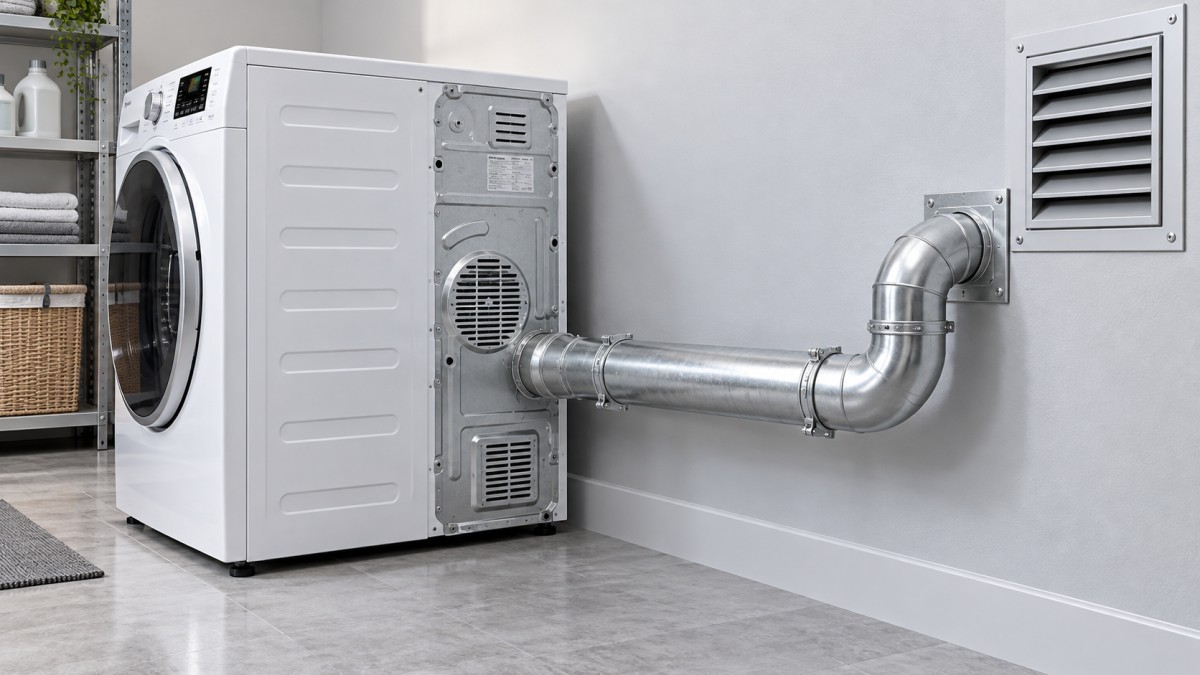
Request the XH80-Z711 installation manual and confirm these model-specific details before approving the route:
- Exhaust connection diameter, outlet position, and permitted connection arrangements.
- Allowed duct materials and any restrictions on flexible connectors.
- Maximum permitted duct length and how bends or fittings affect that allowance.
- Any stated exhaust-resistance limit and the required verification method.
- Installation clearances and access needed for servicing.
These values should come from documentation for the exact supplied version. Do not infer them from another dryer with a similar capacity. Where the proposed route exceeds the manufacturer's limits, redesign it rather than assuming an additional fan will solve the problem. Any assisted-exhaust arrangement needs explicit technical review.
Room air supply belongs in the same discussion
Exhausted air has to be replaced. A tightly enclosed laundry cupboard can restrict operation even when its duct reaches outdoors. Ask the mechanical designer to review the room's air-supply provisions alongside the dryer instructions, particularly where doors remain closed during use.
For shared laundry rooms, assess the intended number of simultaneously operating machines. Bathroom fans, kitchen extraction, and other building systems can influence pressure conditions. Where combustion appliances are present, potential backdrafting requires assessment by a qualified professional.
Do not connect multiple dryers to a common duct simply because a service shaft is available. Shared exhaust introduces questions about backflow, lint accumulation, balancing, and fire separation. It requires a specifically engineered arrangement that is compatible with the appliances and local requirements.
Leave room for cleaning, not just installation
Lint management continues beyond the user-accessible filter. The exhaust route needs inspection and cleaning access, especially at changes of direction and other potential collection points. Concealing the entire route behind permanent joinery can turn routine maintenance into building work.
Specify duct construction and jointing in accordance with the installation instructions and applicable requirements. Avoid arrangements that can sag, become crushed, or create internal obstructions that catch lint. Where ductwork passes through cooler spaces, ask the designer whether condensation control is necessary.
Responsibility also needs to be clear. Who disconnects the appliance, cleans the duct, accesses the outdoor terminal, and restores the connection? A high-level outlet may be acceptable technically but awkward to maintain. Record the access method and assign maintenance responsibility before handover.
Check the laundry workflow alongside the duct layout
Exhaust planning should not obscure capacity matching. If the project pairs the dryer with the XIAOYA Washer XQG120-98922丨12kg, its listed 12kg wash capacity exceeds the dryer's stated 7kg capacity. A full washer load may therefore need to be divided for drying, subject to fabric type and program limits. That affects loading practices and shared-laundry throughput.
The washer's listed dimensions are 600 × 635 × 850 mm, and its maximum spin speed is 1400rpm. Neither figure establishes dryer dimensions, stacking compatibility, or drying time. Check both appliances' installation drawings separately, including door movement, service clearances, utility connections, and any approved stacking equipment.
Make route approval a procurement checkpoint
Founded in 1979, Shandong Xiaoya Group Household Appliances Co., Ltd. develops and manufactures front-loading washing machines, wall-mounted mini washers, and tumble dryers. Its OEM and ODM services and export support provide a basis for coordinating equipment requirements with project documentation. For this installation, request confirmation of the exact dryer version, electrical supply, destination-market compliance documents, and exhaust requirements—not just a general product brochure.
Keep the approved route drawing, supplier responses, penetration details, and installer scope together. Agree on commissioning checks before installation, including connection inspection, termination operation, and any airflow or resistance checks required by the manufacturer. An unloaded demonstration alone does not establish that a concealed duct route is acceptable.
If no compliant, maintainable outdoor route is available, reconsider the appliance location or evaluate a non-vented drying option with its own utility and ventilation requirements. The purchase decision should follow a workable exhaust design, rather than leave the installation team to solve one after delivery.

Request A Quote?
Stay updated with our latest news. We promise not to spam!