






XH80-Z801 Dryer Electrical Requirements: What to Confirm First
XH80-Z801 Dryer Electrical Requirements: What to Confirm First
Before approving the Vented Dryer XH80-Z801 丨8kg for a target market or installation, verify its electrical requirements rather than assume compatibility from capacity alone. Start with the model’s rating plate and supplier documentation: rated voltage, frequency, input power, and current. Then check the supply arrangement, earthing, plug, circuit protection, and applicable local requirements. An 8kg capacity describes the laundry load; it does not establish the electrical load.
The available information does not establish the XH80-Z801’s electrical ratings. A specific supply voltage, breaker size, or plug type therefore cannot be responsibly recommended yet. The useful starting point is an approval checklist tied to the exact version being purchased—not a generic dryer specification.
Identify the electrical version before reviewing the installation
Request a clear rating-plate photograph from the proposed production configuration, together with its installation manual and electrical specification sheet. Check that the model designation, any market-specific suffix, and document revision agree. A quotation showing only “XH80-Z801” may not distinguish every electrical configuration offered for different destinations.
The initial review should resolve these points:
- Rated voltage or voltage range, frequency, and supply configuration.
- Rated input power and current, including what each figure represents.
- Protective class and required earthing arrangement.
- Supplied cord, plug, or approved fixed-connection method.
- Manufacturer-specified circuit and protective-device requirements.
Distinguish total appliance input from heater power. A heater specification alone may exclude the motor, controls, and other electrical loads. If the documents provide different figures, ask the supplier to reconcile them in writing before using either value for installation planning.
Voltage compatibility also does not prove frequency compatibility. A plug adapter changes neither. Where the destination supply differs from the nameplate, obtain confirmation of a suitable factory configuration rather than treating an adapter or external transformer as an automatic solution.
Separate appliance ratings from circuit design
Once the ratings are confirmed, assess the premises supply. Check available voltage, supply conductors, socket rating, existing circuit loads, and any restrictions in the installation instructions. A socket that physically accepts the plug is not evidence that the circuit is suitable.
Dividing input power by voltage can provide a rough current check for a predominantly resistive load. It is not a substitute for the declared appliance current or a method for selecting the final breaker. Motor starting characteristics, conductor installation conditions, protective-device behavior, and local wiring rules still matter.
This distinction becomes practical in a utility room where the washer and dryer may run together. Review their simultaneous demand, not just each appliance separately. Whether a dedicated circuit is necessary must be determined from the manufacturer’s instructions and applicable installation rules. Do not assume an existing washer outlet can also serve the dryer.
Have a qualified local electrical professional confirm conductor sizing, overcurrent protection, and any residual-current or ground-fault protection requirements. Avoid specifying a universal breaker rating before those checks are complete.
Check the complete connection—not just the plug face
For an appliance requiring protective earthing, the earth path must remain continuous through the approved cord and connection arrangement to the building installation. Never assume that a metal cabinet, a three-pin appearance, or an adapter establishes a sound protective-earth connection.
Request the cord-set specification, plug identification, conductor details, strain-relief arrangement, and terminal diagram where relevant. Confirm whether the appliance arrives ready to connect or requires an authorized installation procedure. Neutral and protective earth must be treated according to the approved wiring arrangement and local rules, not improvised on site.
A connection diagram is particularly useful when comparing the factory configuration with the destination supply:
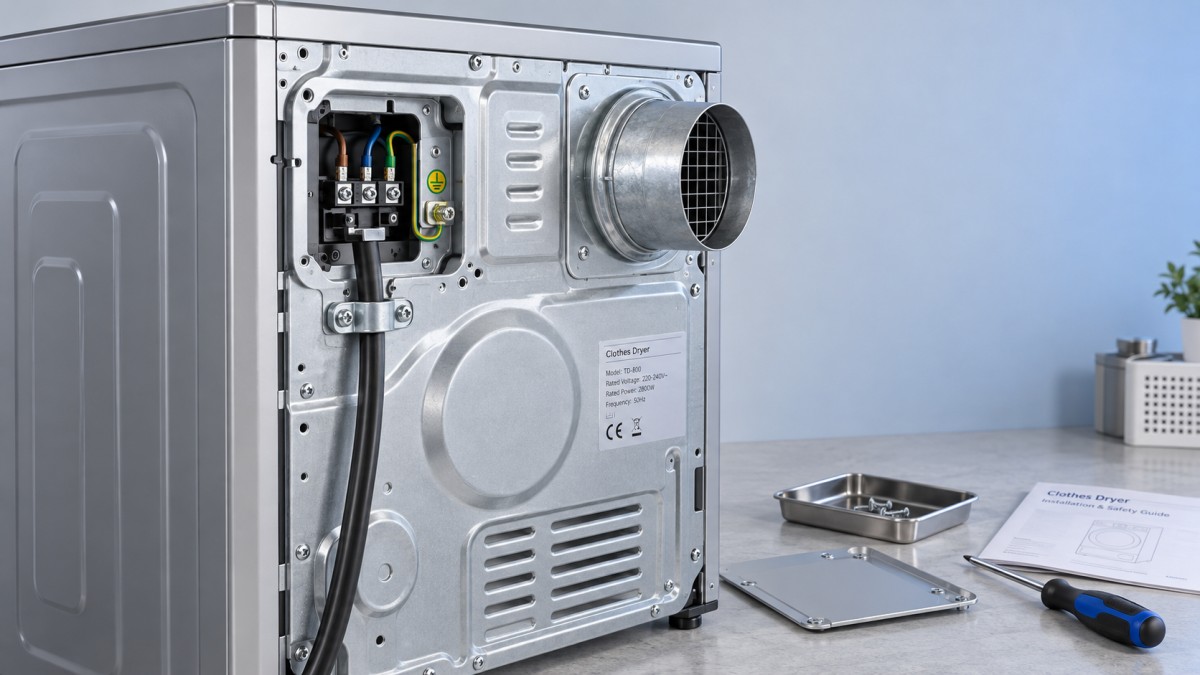
Do not use extension leads or multiway adapters to solve an outlet mismatch. Follow the installation instructions and arrange a suitable permanent outlet or approved connection instead. Repeated tripping also needs investigation; increasing the breaker rating without checking the appliance and wiring can remove necessary protection.
Keep washer specifications out of the dryer approval
Laundry packages create an easy documentation trap. The XIAOYA Washer 75912E丨8kg, for example, lists 110–120V/60Hz and 220–240V/50Hz electrical options, an 8kg capacity, and a maximum spin speed of 1400rpm. Those are washer specifications. They do not establish the dryer’s voltage, current, or certification status.
Nor should the washer’s listed voltage options be read as proof that every delivered unit automatically accepts both supplies. Confirm the selected version for each appliance. When evaluating a paired installation, keep separate electrical schedules and compliance records, then assess their combined demand at the premises.
Ask what the compliance evidence actually covers
An international certification statement is a starting point, not model-specific approval evidence. Request documentation identifying the dryer model, electrical version, applicable standards, and any conditions attached to the evaluation. Where certificates or listings are supplied, check their scope and current status through the relevant issuing body where possible.
For markets using an IEC-based safety framework, IEC 60335-1 and the tumble-dryer-specific IEC 60335-2-11 may be relevant. The applicable national adoption, edition, deviations, and approval route still need confirmation. Safety evidence also does not automatically satisfy separate electromagnetic compatibility, energy, labeling, or importer obligations.
Electrical review should not ignore venting. Restricted airflow can cause overheating and operation of thermal protection. Confirm the permitted exhaust arrangement, clearances, and maintenance access from the installation manual rather than assigning every shutdown or heating complaint to the power supply.
Close the gaps before releasing the order
Founded in 1979, Shandong Xiaoya Group Household Appliances Co., Ltd. manufactures washing machines and tumble dryers and provides OEM and ODM services for export markets. For this review, the useful supplier deliverable is a configuration-specific technical pack: rating plate, electrical data, installation instructions, connection details, and applicable compliance evidence.
Record the approved voltage, frequency, cord set, documentation revision, and market version in the purchase specification. If an OEM change affects electrical components, wiring, or protective devices, ask whether further compliance assessment is required. Release the XH80-Z801 for installation only when the supplied configuration, documented requirements, and actual site supply agree.

Request A Quote?
Stay updated with our latest news. We promise not to spam!